Jacob Poot
Hans Brinker, or The Silver SkatesJacob Poot is a stout, genial boy whose comic reputation rests on his size and exertion, but whose place in the story is secured by loyalty and good nature. He helps launch the boys’ long skating journey, persists until his strength gives out, and remains part of their later adventures. The retrospective ending gives his buoyant presence a final poignancy: Jacob is remembered as the only one of the Holland friends who has died.
Identity and Introduction
Jacob is introduced by his unmistakable build: as the stoutest boy in the neighborhood, he can be recognized by his form before the others can make out his features. He arrives with his English cousin, Benjamin Dobbs, who is staying with him through the great skating race. The boys quickly make Jacob’s body a subject of jokes, but the narrative also establishes the warmth beneath the teasing. His cousin’s arrival brings him into the wider group, and Jacob is at once both its most conspicuous figure and an eager participant in its plans.
His humor is physical and direct. When little Voostenwalbert Schimmelpenninck volunteers to join the journey, Jacob laughs at the idea that so small a boy could manage it and points to the padded headgear worn by very young children. Voostenwalbert answers by turning the joke back on Jacob’s own bulk. Their exchange sets a pattern: Jacob can be laughed at and can laugh with the others, without becoming an outsider to the group. The comedy depends on the boys’ familiarity with one another, not on Jacob’s exclusion.
The Journey and Its Ordeal
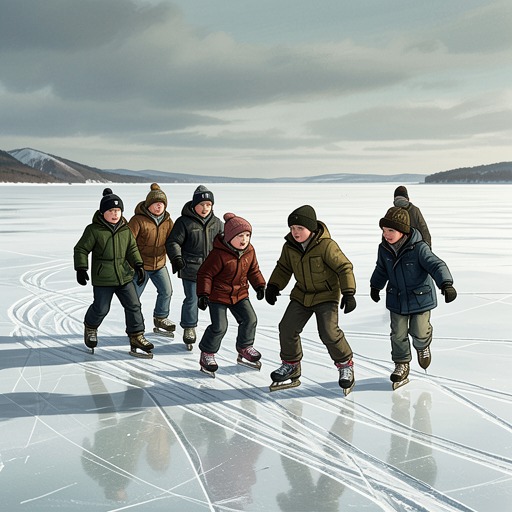
Jacob and Benjamin Dobbs have permission to make an ambitious skating journey from Broek to The Hague, nearly fifty miles, taking advantage of the Saint Nicholas holiday and extra days granted while the schoolhouse is cleaned. Jacob announces the plan and invites the other boys to join. The scale of the trip makes his decision consequential: this is not a brief outing but a test of endurance, and his invitation turns a private plan into a shared expedition.
The journey also shows Jacob thinking practically about the party’s money. He later tells Benjamin that it was his idea for all the boys to put their purses together with the Van Holps’ money. When the party grows desperately hungry, Benjamin reassures him that he had meant well. Jacob’s regret shows that he feels responsible for the plan, while Benjamin’s response preserves their trust. Jacob is not presented as a strategist who can foresee every difficulty; he is a companion whose good intentions matter even when the arrangements leave the boys in trouble.
His physical limit arrives on the ice. Jacob tries to conceal his fatigue and conserve his breath by saying nothing, but his heavy body becomes harder to move and his limbs weaken. He grows flushed and then suffers a sudden spell of vertigo: the canal seems to rock, the sails appear to spin, and he falls heavily onto the ice. The episode converts the trip’s cheerful test of stamina into a practical emergency. The others cannot expect him to skate farther that day, and they must find a way to get him to Leiden.
A little schnapps brings a faint flush back to Jacob’s face, and he opens his eyes, bewildered and embarrassed. The remedy does not make him fit to resume the journey; he still has to be transported. After other possible help fails, the boys manage to hoist him into an iceboat. Jacob feels better once they are moving, but the scene’s importance lies less in recovery than in the group’s response: they do not leave him behind, and their skating plans give way to getting him safely onward.
Companion in the Group’s Adventures
Jacob’s presence at the Red Lion Inn produces another comic reversal. During the night’s confusion over the intruder, he is asleep and does not understand what has happened. When he wakes, the others call for him to help, and he slides to the floor wrapped in the bedclothes, takes in the situation, and sits heavily on the robber’s back. His arrival helps hold the man down while Peter van Holp takes the pistol from the robber’s belt and arranges to go for the police with Lambert van Mounen.
At the police court the next morning, Jacob’s account adds to the discrepancy between what the boys experienced and what they think they saw. He testifies that the robber woke him by kicking and thrashing on the floor. Peter van Holp and the others explain that the man had not moved after the dagger touched his throat and that he remained bound while they inspected him. Jacob’s sleepy understanding is therefore not a reliable account of the whole capture, but it is an honest report of the moment that woke him. The contrast keeps the episode light without making Jacob’s testimony malicious or deceptive.
The narration later makes his body a comic participant in school life as well as in skating. On the morning of his return, Jacob’s bones ache at every stroke of the school bell, as though warning him that lessons are coming; after school they settle comfortably among their cushions. This playful account makes physical discomfort a sign of his reluctance to study, not a new crisis. It also connects the exhaustion of the journey with the ordinary rhythms that resume once the boys are home.
The Race and the Group’s Affection
At the skating race, Jacob is among the boys who set out, but halfway along he has fallen far behind. He stops, wipes his hot face, removes his cap, and looks around; rather than force himself onward, he gives up with a hearty, astonished laugh. The other boys are nearly at the boundary, yet the scene does not turn his failure into humiliation. His laughter wins him friends among the spectators, and he soon stands with them, watching the race as eagerly as anyone.
The change in his position is telling. On the journey he had invited the boys into an undertaking that he could not finish; at the race he recognizes his limit and accepts it without bitterness. He is no longer one of the skaters contending for the finish, but he remains part of the occasion. The account’s shift from the spectacle of his lagging behind to his eager place among the onlookers preserves the humor while making clear that the group’s regard for him does not depend on winning.
Change and Retrospective Significance
The closing glimpse of Jacob comes years later, after the story has followed the childhood group into adult life. He is the only one of those Holland friends who has passed away. The narrator remembers him as good-natured, true-hearted, and unselfish to the last, placing those qualities beside the affectionate laughter that accompanied him in life. The words recast his earlier comedy: his size made him easy to notice, but kindness and generosity are what define his remembered character.
Even the final comparison keeps faith with the book’s recurring attention to Jacob’s body. He had grown very thin before he died, thinner even than Benjamin Dobbs, who by then was the most portly of the group. The reversal is quietly striking: the stoutest boy, once recognized by his shape from afar, is remembered at the end through the change in that shape. No cause or date of death is supplied. Instead, the narrative measures his absence through the friends who remain and the affection with which they mourn him.
Jacob’s role is thus larger than that of a comic companion, though comedy is central to his scenes. His fatigue forces the skating party to care for one another; his arrival helps restrain the robber; his failure to finish the race becomes a moment of shared amusement rather than rejection. Across these episodes, the story makes fellowship visible in practical acts and easy laughter. The final remembrance completes that portrait by separating the affection he inspired from the jokes made at his expense: Jacob was laughed with, loved, and mourned.